Original Watercolor Art for Minimalist Homes
Table of Contents
Last Updated: October 21, 2026
Why Original Watercolor Art Works in Minimalist Spaces
Original watercolor art for minimalist homes creates a powerful visual anchor without overwhelming a serene interior. Watercolor's translucency and flow complement clean lines and neutral tones, and originals bring genuine artistic intention into your space.
Minimalist design thrives on intentionality, and a hand-painted watercolor becomes a focal point because it's singular, thoughtful, and real.
At Art By Jd, we create original watercolor pieces for spaces that value restraint and elegance.
Pro Tip The secret to integrating art into a minimalist room isn't about choosing the smallest piece, it's about choosing one piece that genuinely speaks to you. A larger original watercolor that you love will feel more restrained than a small print you tolerate.
How to Choose Art for a Minimalist Home
Most guides stop at "pick something you love." What follows is a practical process for selecting original watercolor art for minimalist homes, organized around role, wall size, palette, and existing furnishings.

Step 1: Define the Artwork's Role Before You Shop
Before browsing, decide whether the piece is a statement anchor or a quiet accent, this narrows every later choice.
Statement anchor: One larger piece (roughly 24x36 inches or larger, or a diptych totaling that width) that becomes the room's focal point. Best for living rooms with a dominant sofa wall, dining rooms, or a stairwell. It can carry more color and contrast because nothing else competes with it.
Quiet accent: A smaller piece (8x10 to 16x20 inches) that reinforces the existing palette. Best for bedrooms, hallways, home offices, and shelves. Choose lower-contrast watercolors with generous negative space so the piece recedes.
Match the role to the wall, not to the price or the artist's popularity.
Step 2: Measure the Wall and Set a Size Range
Minimalist rooms reward proportion over quantity. Rules of thumb:
Above furniture: Artwork should span roughly 50-75% of the furniture width. A 72-inch sofa pairs with a piece (or pair) 36-54 inches wide; a queen bed (60 inches) with art 30-45 inches wide.
On an empty wall: Aim for roughly 4-6% of the total wall square footage for an accent, or 8-12% for a statement piece. An 80 sq ft wall suggests 3-5 sq ft of art for an accent, roughly one 24x36 inch framed piece.
Hanging height: Center the artwork at 57-60 inches from the floor (museum standard), or align it with the average viewer's eye line.
Write these numbers down before you shop. They convert a subjective decision into a filter.
Step 3: Build a Palette From What Is Already in the Room
Pull three colors from the room, wall color, dominant furniture finish, and one accent, then choose a strategy:
Harmony: The painting's dominant hues echo two of the three room colors. Safest for very neutral rooms.
Single-point contrast: The painting introduces one saturated hue not present elsewhere. Because the rest of the room is restrained, one strong color reads as intentional, not chaotic.
Tonal match: The painting uses the same family (all warm neutrals, all cool grays) at a different value. The most minimalist option and easiest to live with long-term.
Avoid matching the wall color exactly. A painting that disappears into the wall reads as a mistake rather than restraint.
Step 4: Check Composition Against the Room's Lines
Minimalist rooms are built on lines, sofa backs, window frames, shelf edges. The painting's composition should echo or deliberately soften them.
Strong horizontal lines (long sofas, low consoles): a watercolor with a strong horizon or horizontal band reinforces calm.
Strong vertical lines (tall windows, bookcases): a portrait-format piece with vertical movement balances the room.
Mostly soft, organic shapes: a geometric watercolor adds structure without clutter.
Treat negative space, unpainted paper, as an active design element; a painting that is 40-60% negative space feels calmer than one that fills the sheet edge to edge.
Step 5: Test Before You Commit
Before hanging, do a low-cost placement test:
Cut a paper template to the exact framed dimensions and tape it to the wall for 24 hours, noticing it at different times of day.
Photograph it from the main viewing position, photos reveal proportion problems the eye forgives in person.
Check the light: watercolor shifts with daylight, so view the piece in the room's actual light before deciding.
Key Takeaway Choosing original watercolor art for a minimalist home is a five-step filter: define the role, measure the wall, build a palette from the room, check composition against the room's lines, and test placement before committing. Each step removes guesswork and keeps the final choice restrained. Room-by-Room Quick Reference Room Typical role Suggested size Palette strategy Living room (above sofa) Statement anchor 36-54 in wide Harmony or single-point contrast Bedroom (above bed) Quiet accent 30-45 in wide Tonal match, low contrast Entryway console Statement or accent 24-36 in wide Single-point contrast for welcome Home office Quiet accent 16x20 to 24x30 in Cool tones for focus Hallway Accent series 3-5 small pieces, 8x10 to 11x14 in Consistent palette across pieces These are starting ranges, not rules. Adjust for ceiling height, furniture scale, and desired visual quiet. Watercolor Art for Small Spaces Small rooms demand strategic art choices: an oversized piece can overwhelm a compact bedroom, while a tiny painting disappears on a large wall. Consider square- or portrait-format watercolors in the 8x10 to 11x14 inch range, substantial without dominating, hung at eye level, roughly 57-60 inches from floor to center of frame. A single, well-chosen original watercolor serves small spaces better than multiple pieces. Avoid placing watercolor art directly opposite a window in small spaces. Backlighting can wash out the subtle color variations that make hand-painted work special. Side or indirect natural light shows the painting's true depth and character.
Assessing Authenticity: Original vs. Reproduction
An original watercolor painting is a one-of-a-kind hand-painted work on watercolor paper; a reproduction is a printed copy produced through commercial printing. Purchasing an original watercolor from an artist like Joylyn Denna at Art By Jd means acquiring a specific object with provenance and genuine artistic intention.
Ask the artist directly about their process. Legitimate artists welcome questions about technique, materials, and creation, and this transparency distinguishes them from sellers of mass-produced or AI-generated imagery.
How to Hang Art in a Rental
Renters face real constraints, no nail holes, and security deposits on the line. Fortunately, original watercolor art for minimalist homes can be displayed beautifully without permanent wall damage.
Damage-Free Hanging Methods
Adhesive picture hangers designed for renters hold surprising weight and remove cleanly; test them on an inconspicuous wall section first. Command strips and similar removable adhesives work well for lighter pieces, a framed watercolor typically weighs 3-5 pounds, well within their capacity. Apply to a clean, dry wall and follow the manufacturer's timing instructions. Leaning art against furniture is another rental-friendly option: a framed original watercolor on a shelf, console table, or mantle creates visual impact without wall commitment.
Portability and Preservation
Original watercolor paintings require gentle handling: the paper is delicate and the pigment can be affected by moisture, sunlight, and temperature fluctuations. When moving, wrap the piece in acid-free paper or cloth and place it in a rigid, padded box. Store flat or vertical, never rolled, in a cool, dry location away from direct sunlight. If you move frequently, consider high-quality reproductions for your rental and display the originals in your permanent home later.
Sizing, Placement, and Framing Guidance
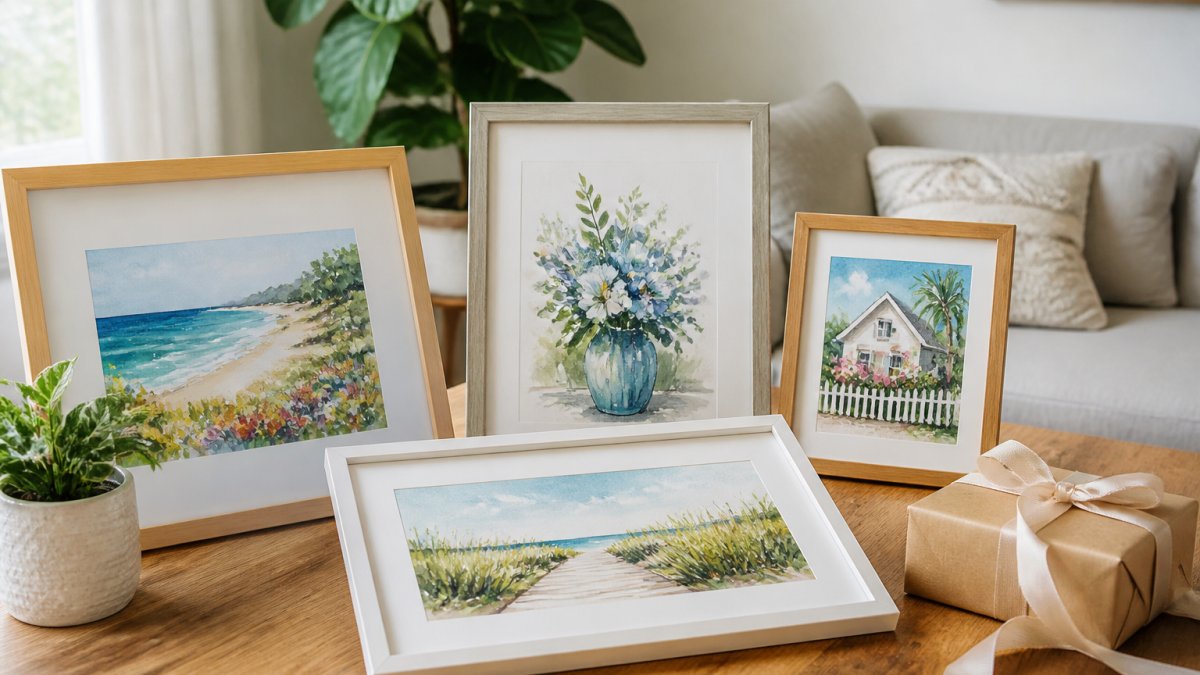
A painting that's too small feels lost; one that's too large overwhelms. The ideal artwork covers roughly 50-75% of the wall space above a piece of furniture, a 60-inch sofa pairs well with a 30-40 inch wide piece or collection. Framing amplifies the impact of original watercolor art: a simple frame in natural wood, black, or white complements minimalist spaces, while ornate frames contradict the restraint minimalist design celebrates.
The Value of Handmade Watercolor Art
"Original art appreciates" is repeated across the category without explanation. The useful question is: what actually drives the price and value of an original watercolor, and how does that differ from a print or a commission? Understanding the mechanics helps you judge whether a piece is fairly priced.
What Drives the Price of an Original Watercolor
Original watercolor pricing is not arbitrary. Artists and galleries weigh a consistent set of factors:
Artist reputation and career stage. An emerging artist's work typically sits well below an established artist's, even at similar sizes. Reputation is built through exhibitions, press, collector base, and consistent body of work.
Size and complexity. Larger sheets and more layered, time-intensive compositions cost more.
Materials. Artist-grade pigments, 100% cotton rag watercolor paper (often 140 lb or 300 lb), and archival framing add real cost. Student-grade materials on wood-pulp paper cost less and age differently.
Buyers often compare an original to a print on price alone and conclude originals are "too expensive."
Original vs. Print vs. Commission: A Practical Comparison
Each format serves a different buyer and budget. The table below summarizes the trade-offs without quoting specific prices, which vary widely by artist.
Factor | Original watercolor | Reproduction / print | Custom commission |
Uniqueness | One of a kind | Multiple copies | One of a kind, made for you |
Relative cost | Highest | Lowest | Mid to high |
Control over subject/size | Whatever exists | Limited to available editions | Full input on subject, size, palette |
Lead time | Immediate (if available) | Immediate | Weeks to months |
Resale potential | Depends on artist reputation | Minimal | Depends on artist reputation |
Best for | Collectors, long-term owners | Renters, first-time buyers, budget-conscious | Gifts, meaningful spaces, specific walls |
How to Judge Whether a Price Is Fair
Use this checklist before purchasing:
Is the artist identifiable and findable? A real artist has a body of work, website, exhibition history, or social presence you can review.
Are materials disclosed? Ask about paper weight and brand, pigment grade, and archival framing.
Is there documentation? A signed certificate of authenticity, title, date, and dimensions are standard for serious original work.
Is the size consistent with the price tier? Compare similar-sized works by the same artist or by artists at a similar career stage.
Is the framing archival? Acid-free matting and rigid backing protect the investment and are often reflected in price.
If an artist cannot answer these questions clearly, slow down, not necessarily to walk away, but to ask more.
What "Appreciation" Really Means for Original Art
Original artwork can increase in value, but it is not a guaranteed investment and should not be bought primarily for financial return.
What original watercolor reliably delivers is non-financial value: a one-of-a-kind object, a direct connection to the artist's process, and a piece that reveals new details over years of viewing. In a minimalist room, that sustained relationship, rather than decoration you tire of, is the real return.
Value in original watercolor comes from four things: the artist's reputation, the materials and craft, the uniqueness of the piece, and the documentation that proves it. Judge price against those factors, not against the cost of a print, and treat appreciation as a possible bonus rather than the reason to buy.
Frequently Asked Questions
How do I know if watercolor art is genuinely hand-painted and not digitally created?
Authentic hand-painted watercolor shows distinct characteristics: visible brushstrokes, slight variations in pigment density, natural color transitions, and unique imperfections that occur during the painting process. Each original piece will have subtle differences that mass-produced or digitally created art cannot replicate. When purchasing from Art By Jd, you're buying directly from the artist, Joylyn Denna, ensuring the artwork is genuinely hand-painted with passion and attention to detail. Ask the artist about their process and request close-up photos if you're unsure.
Can I display original watercolor art in a rental without damaging the walls?
Yes, absolutely. Damage-free hanging methods like adhesive strips, magnetic strips, or removable picture hooks allow you to display watercolor art safely in rentals. These options hold lightweight framed pieces securely without leaving permanent marks. When you move, simply remove the hanging hardware carefully, and your walls remain pristine. This flexibility makes original watercolor art ideal for renters who want to personalize their space without sacrificing their security deposit.
What size watercolor art works best in small minimalist spaces?
Smaller pieces, typically 8x10 inches to 12x16 inches, work beautifully in compact rooms without overwhelming the space. Square or portrait-format compositions feel more intimate and balanced in tight areas. A single focal point, one well-chosen watercolor piece, maintains the minimalist aesthetic better than multiple smaller artworks. Consider the wall space available and ensure the piece has breathing room around it. This restraint is core to minimalist design and lets the original watercolor art become a statement rather than clutter.
Why is original watercolor art worth the investment compared to mass-produced prints?
Original hand-painted watercolor art carries intrinsic value: each piece is unique, created with intention by a specific artist, and tells a personal story through its creation. Mass-produced prints are copies without that authenticity or connection. Hand-painted art from Art By Jd brings genuine craftsmanship, emotional resonance, and lasting beauty to your home. The investment supports the artist directly and ensures you own something truly one-of-a-kind that will appreciate in meaning and often in value over time.
Get Started Today
Comments